
Introduction
Artificial intelligence and machine learning (AI/ML) have moved from a novelty in medtech to a routine feature of FDA clearances. By the end of the first half of 2026, the cumulative count of FDA-authorized AI/ML-enabled medical devices stood at 1,606, spanning 551 unique sponsor companies and dating back to the first authorization in 1995.
This report looks specifically at what changed in the first six months of 2026: which specialties are gaining or losing share, what kinds of AI functionality are reaching the market, which regulatory pathways sponsors are using, and where the earliest signs of next-generation AI architectures are starting to show up in FDA submissions.
Consistent with prior industry analyses of this space, we focus here on two dimensions: innovation (what is being built, and by whom) and regulation (how the FDA is classifying and processing these products).
Key Findings
- Growth has leveled off, at least on the surface. Authorizations from January to May 2026 (143) came in essentially flat versus the same period in 2025 (153). The first year without visible year-over-year growth in over a decade. June 2026 data is still incomplete (only 2 devices logged) due to normal FDA publication lag, so the true H1 2026 figure is likely higher once fully reported.
- Radiology's dominance is easing, slowly. Radiology's share of new authorizations has declined every year since 2022 from 84% to under 74% in H1 2026, as cardiology, neurology, gastroenterology, orthopedics, and dental applications pick up share.
- 510(k) remains overwhelmingly the pathway of choice. Of all 1,606 authorizations to date, 96% came through 510(k) clearance, versus 2.7% De Novo and 1.4% PMA. That mix was essentially unchanged in H1 2026.
- Image analysis still defines the category, but new functional classes are emerging. An estimated 79% of authorized devices perform some form of automated image detection, segmentation, reconstruction, or classification. Real-time navigation and personalized procedure-planning tools grew as a share of H1 2026 authorizations relative to their historical base.
- The market keeps widening. 33 companies received their first-ever AI/ML device authorization in the first half of 2026 alone, spanning the US, China, South Korea, Denmark, France, Portugal, Japan, and the Netherlands.
Innovation: A Maturing but Still-Concentrated Field
Growth is decelerating for the first time
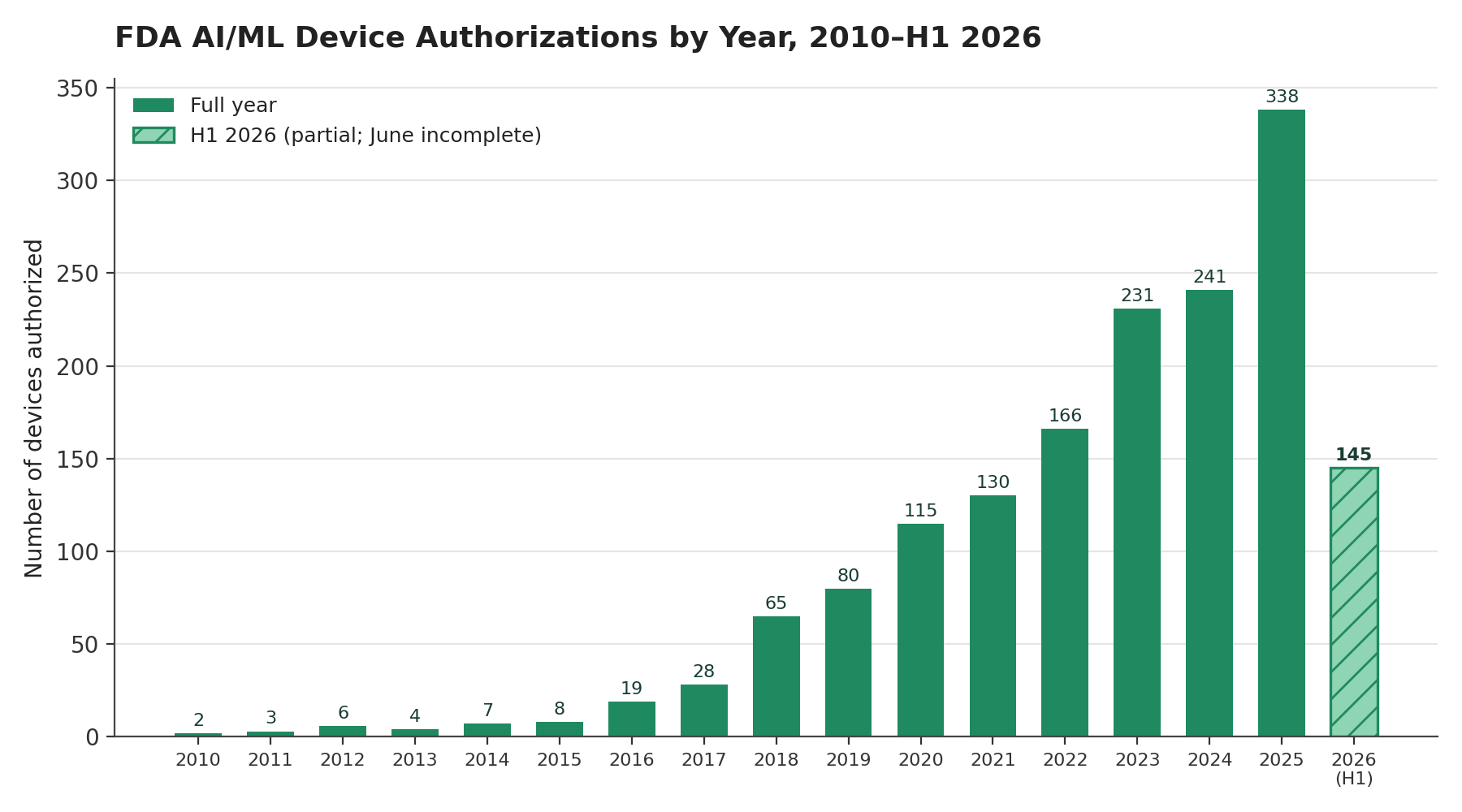
Annual AI/ML device authorizations have risen almost every year since 2015, from single digits to a peak of 338 in 2025. Early data in 2026 suggests the pace may finally be flattening:
| Period | Devices Authorized |
|---|---|
| 2022 (full year) | 166 |
| 2023 (full year) | 231 |
| 2024 (full year) | 241 |
| 2025 (full year) | 338 |
| Jan–May 2025 | 153 |
| Jan–May 2026 | 143 |
Because the FDA typically takes several weeks to publish newly authorized devices, June 2026 in our data set shows only 2 authorizations. Comparing the more reliable Jan–May windows, 2026 is tracking about 6% below the same period in 2025. This is the first time that year-over-year growth has not been clearly positive. Whether this reflects a genuine plateau, a temporary pause as sponsors absorb updated FDA guidance, or simply noisy early-year data will only become clear as the rest of 2026 is reported.
Radiology still leads, but its grip is loosening
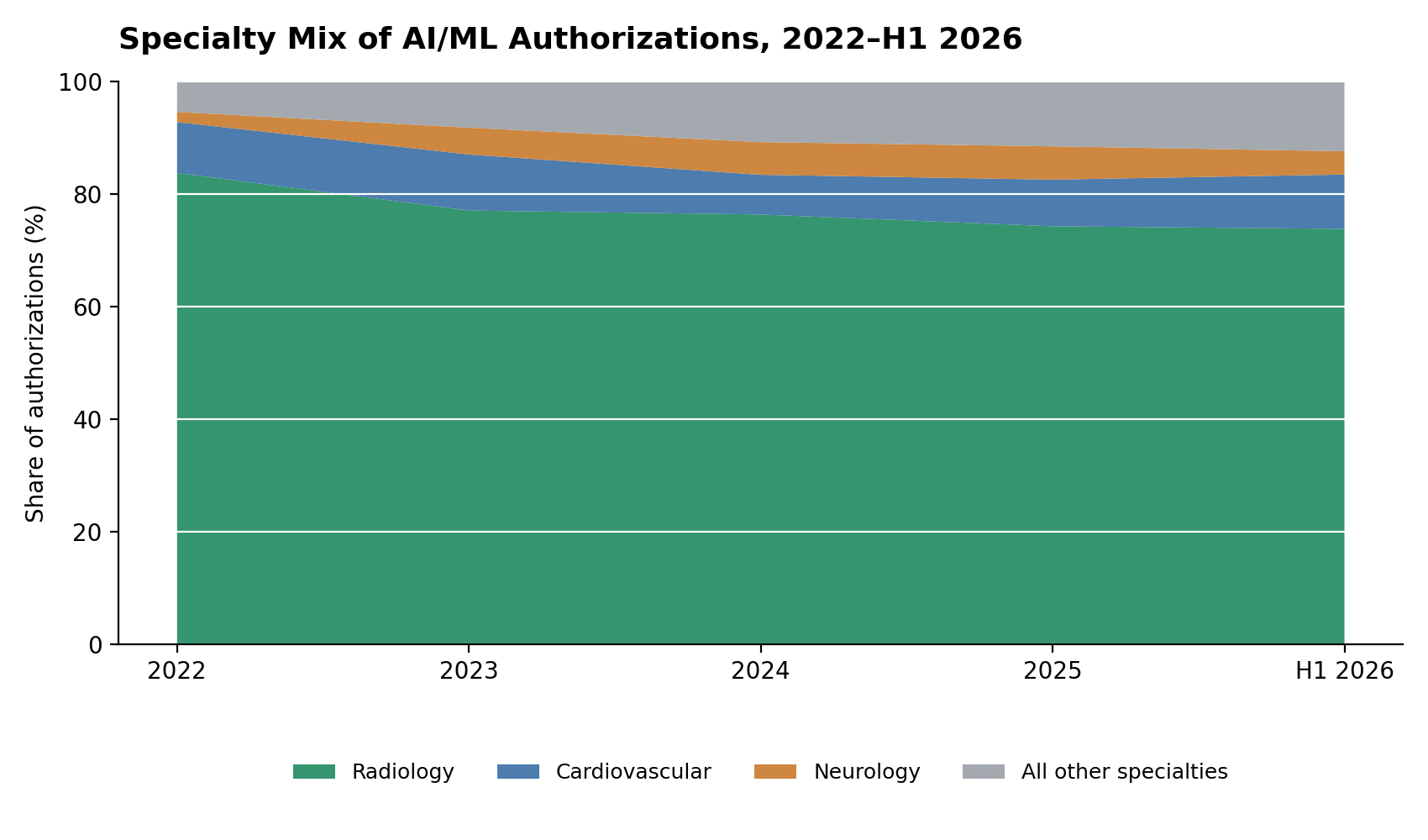
Radiology remains the single largest application of AI/ML in medtech, but its share of new authorizations has been declining steadily:
| Year | Radiology Share | Cardiovascular Share | Neurology Share |
|---|---|---|---|
| 2022 | 83.7% | 9.0% | 1.8% |
| 2023 | 77.1% | 10.0% | 4.8% |
| 2024 | 76.3% | 7.1% | 5.8% |
| 2025 | 74.3% | 8.3% | 5.9% |
| H1 2026 | 73.8% | 9.7% | 4.1% |
Cardiovascular applications have held a steady 7–10% share for four straight years, driven by ECG interpretation algorithms, structural heart navigation platforms, and rhythm-monitoring devices from sponsors like iRhythm, Anumana, and established EP navigation vendors. Neurology, gastroenterology, orthopedics, dental, and general hospital use cases collectively made up over 16% of H1 2026 authorizations. It is a meaningfully larger footprint than three years ago.
Devices authorized outside radiology and cardiology in H1 2026 illustrate this diversification well: a sepsis early-warning system for general hospital use (Bayesian Health), a home sleep-staging device (Onera SleepMap), an autism-spectrum assessment tool (EarliPoint), an at-home flu/COVID-19 diagnostic (Visby Medical), two dental design/diagnostic systems (3Shape, Chohotech), and three orthopedic surgical-planning or navigation systems (Stryker, Orthosoft, Precision AI).
What the devices actually do
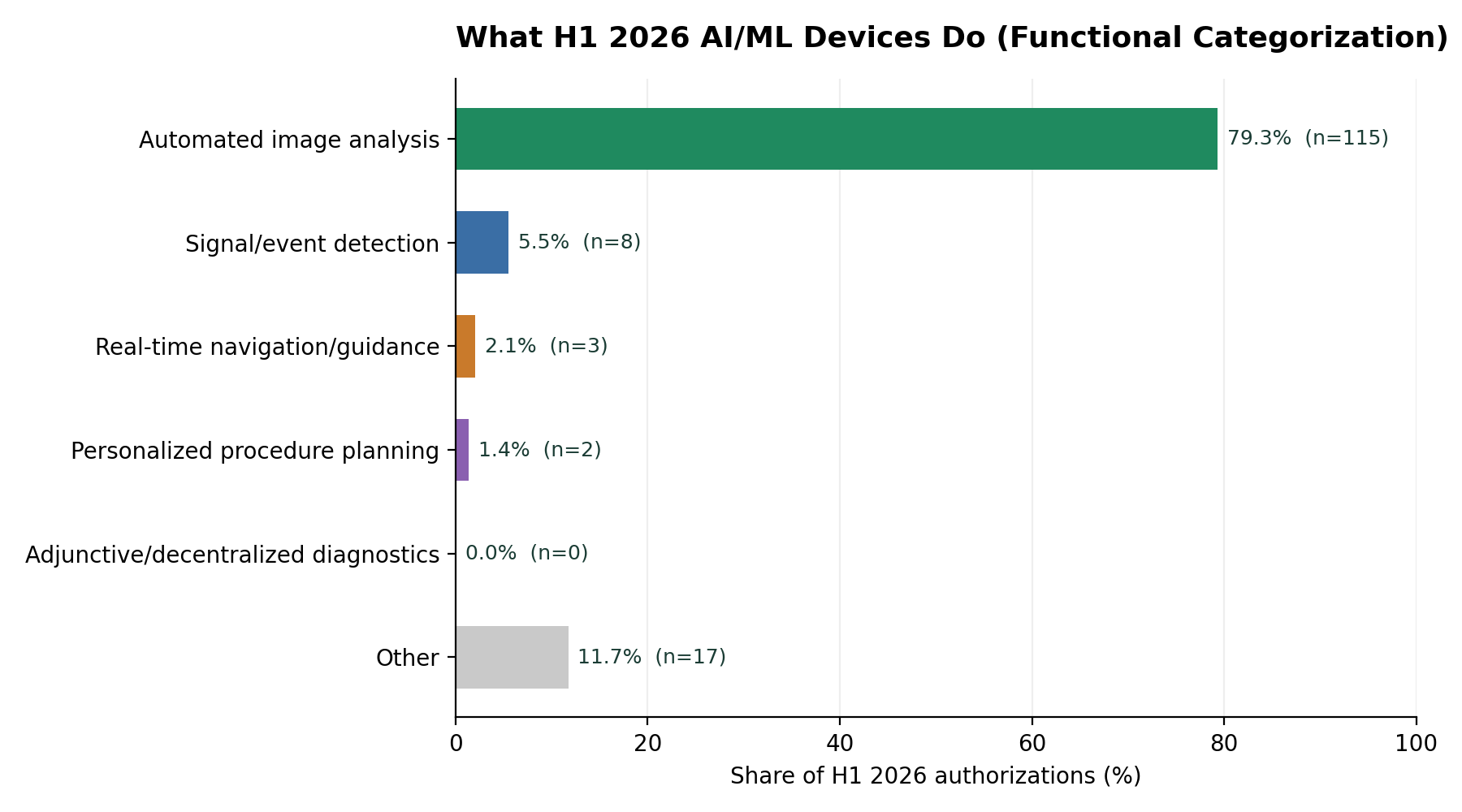
Categorizing devices by their underlying AI function (based on device names and FDA summary descriptions) shows a field still overwhelmingly organized around image interpretation, but with early growth in other functional classes:
| Functional Category | Share, All-Time (n=1,606) | Share, H1 2026 (n=145) |
|---|---|---|
| Automated image analysis (detection, segmentation, reconstruction, denoising, CAD) | ~79% | ~79% |
| Signal/event detection (ECG, EEG, respiratory, acoustic, sleep) | ~4% | ~5.5% |
| Real-time navigation/procedural guidance | ~0.5% | ~2.1% |
| Personalized procedure planning | ~0.4% | ~1.4% |
| Adjunctive/decentralized diagnostics (point-of-care, home, wearable) | ~0.7% | — |
Note: this categorization is derived from keyword analysis of device names and FDA summary text rather than a formal FDA taxonomy, and should be read as directional rather than precise.
The modest but real uptick in navigation and procedure-planning devices in H1 2026, including Medtronic's Stealth AXiS cranial and spine navigation applications, Stryker's Blueprint patient-specific instrumentation, and Precision AI's surgical planning system, suggests that AI is beginning to move beyond passive image review and into active procedural support, even if the absolute numbers remain small.
Capital equipment OEMs vs. software-first sponsors
A useful lens on where innovation is concentrated is whether the sponsor is a traditional capital-equipment OEM (like GE, Siemens, Philips, Canon, Samsung, Fujifilm, United Imaging, and similar) or a software-first company building algorithms that run on top of existing hardware.
- All-time: roughly 25% of authorizations (399 of 1,606) came from capital-equipment OEMs; the remaining 75% came from software-first or other sponsors.
- H1 2026: the OEM share ticked up to about 31% (45 of 145), driven by a wave of reconstruction, denoising, and image-quality algorithms from GE, Siemens, Philips, and Canon, alongside four new clearances from Shanghai United Imaging Healthcare and its Wuhan affiliate.
Even so, software-first companies (Aidoc, Lunit, RapidAI, viz.ai, Subtle Medical, Overjet) continue to account for the majority of new authorizations, reflecting a market where the barrier to bringing an AI algorithm to market remains lower than the barrier to building imaging hardware.
The market keeps widening
Even as aggregate growth flattens, the roster of companies participating in AI/ML medtech continues to expand. 33 companies received their first-ever FDA AI/ML device authorization in the first half of 2026 alone, including entrants from China (Wuhan United Imaging, Hangzhou Chohotech), South Korea (Neurophet), Denmark (3Shape), France (Median Technologies), Portugal (DigestAid), Japan (Shimadzu), and the Netherlands (Onera, MedicalVR).
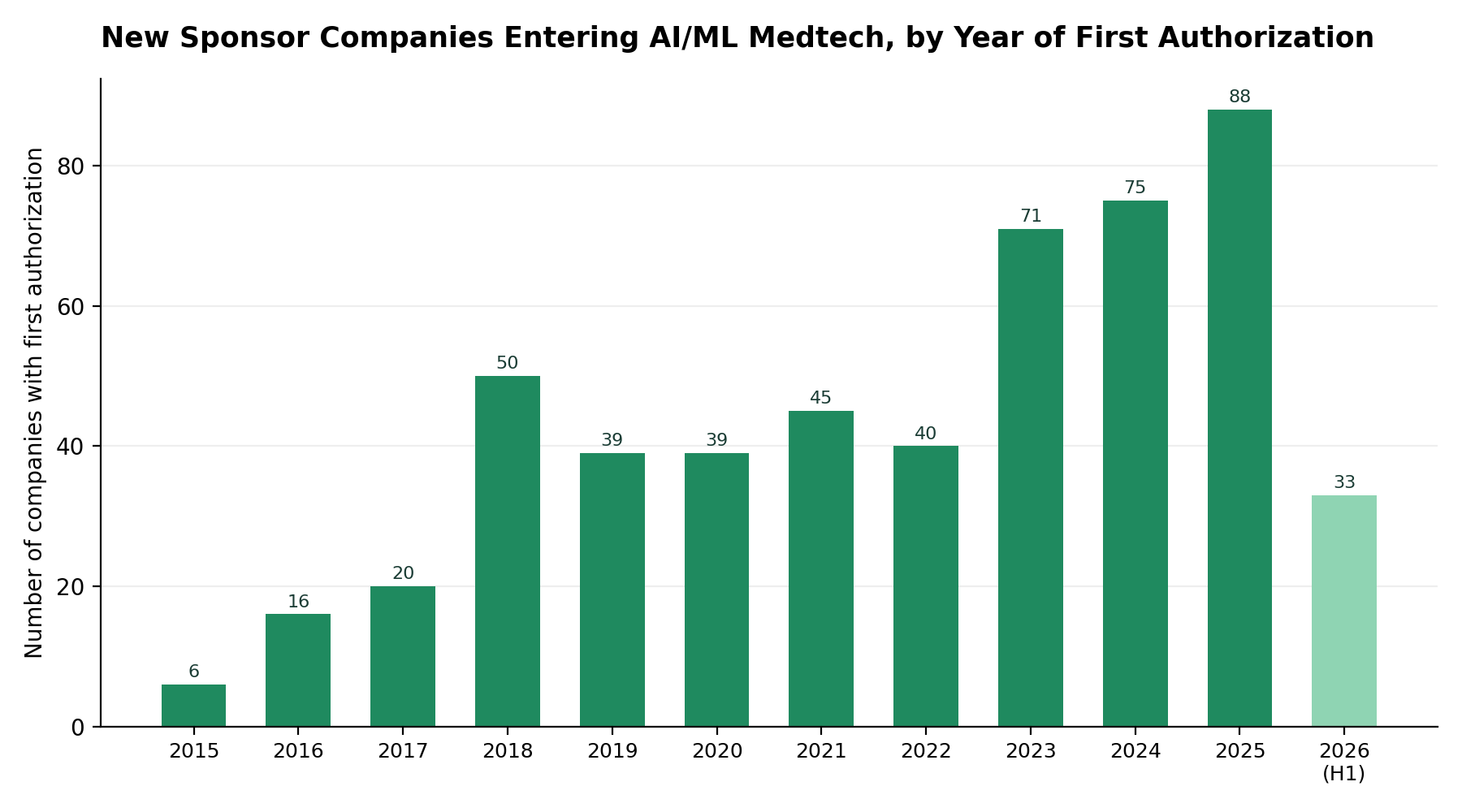
Consistent with earlier industry analyses of this space, familiar international hotspots continued to punch above their weight in H1 2026: South Korea (Lunit, Neurophet, Coreline Soft), Israel (Aidoc, MAGENTIQ Eye), and China (Shanghai/Wuhan United Imaging) all had multiple sponsors receive clearances, alongside the dominant base of US-headquartered software and OEM companies.
Regulation: steady pathways, early signs of change
510(k) still dominates, with little sign of movement
The regulatory pathway mix for AI/ML devices has been remarkably stable. Of the 1,606 devices authorized to date, 1,541 (96.0%) went through the 510(k) pathway, 43 (2.7%) through De Novo, and 22 (1.4%) through Premarket Approval (PMA). That mix held in H1 2026: 142 of 145 authorizations (98%) were 510(k) clearances, with just 2 De Novo grants and 1 PMA approval.
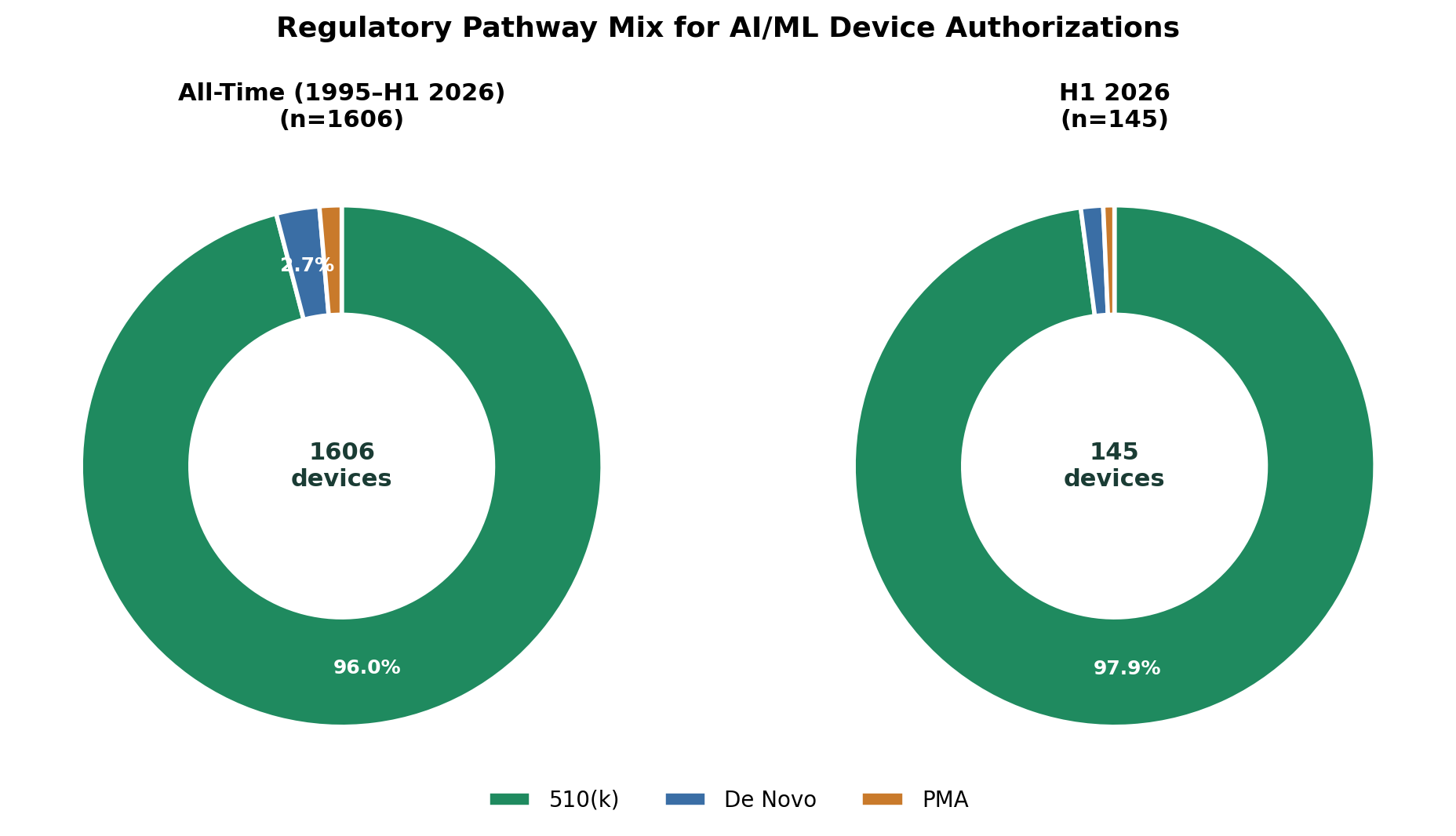
The rarity of De Novo and PMA pathways for AI/ML devices reflects the maturity of the predicate landscape: as more AI-enabled devices reach the market, newer entrants increasingly have an existing cleared device to point to as a predicate, reducing reliance on pathways reserved for genuinely novel device types.
The De Novo and PMA devices that did break through
The handful of devices that did require a De Novo or PMA pathway in 2025–H1 2026 are worth a closer look, since they typically represent genuinely new categories of AI-enabled functionality:
| Device | Company | Pathway | Date | What It Does |
|---|---|---|---|---|
| Tyto Insights for Eardrum Bulging Detection (DEN250014) | Tyto Care | De Novo | Mar 2026 | Over-the-counter, web-based AI analytics for detecting eardrum bulging from consumer otoscope images |
| Claire™ OCT System (P250008) | Perimeter Medical Imaging | PMA | Mar 2026 | Real-time 3D optical coherence tomography with AI-based margin/lesion detection for surgical use |
| Delivery Date AI (DEN250007) | Ultrasound AI | De Novo | Feb 2026 | ML-based post-processing of pregnancy ultrasound images to estimate delivery date |
| ArteraAI Prostate (DEN240068) | Artera | De Novo | Jul 2025 | AI-based prognostic/predictive test for prostate cancer treatment planning |
| Allix5 (DEN240047) | Clairity | De Novo | May 2025 | AI-based mammography image analysis for breast cancer risk assessment |
| Jewel Patch Wearable Cardioverter Defibrillator (P230022) | Element Science | PMA | Apr 2025 | Wearable defibrillator with ML-based ventricular tachycardia/fibrillation detection |
Several of these (the over-the-counter otoscopy device, the wearable defibrillator, and the OCT margin-detection system) extend AI/ML functionality into settings (consumer use, wearables, intraoperative real-time imaging) that go beyond the traditional PACS-based radiology workflow that has defined the category since its inception.
The first signs of foundation models
Perhaps the most notable regulatory development is the emergence of devices whose FDA summary language explicitly references foundation models architectures, the building blocks of generative AI:
- BriefCase-Triage: CARE Multi-Triage CT (K253578, Aidoc Medical, cleared February 2026) described in its FDA summary as using "a foundation model-based artificial intelligence (AI) system" to analyze CT images and flag findings across multiple conditions in parallel with standard-of-care interpretation.
The device is not a generative AI system in the sense of producing open-ended text or images; it uses foundation model-style architectures for classification and detection tasks within tightly bounded clinical outputs. Still, its appearance marks a meaningful shift from the convolutional neural network and gradient-boosting approaches that have defined the category for the past decade, and suggests that foundation-model architectures are beginning to enter FDA-regulated products through the back door of improved detection and multi-condition triage performance.
Outlook
Three threads are worth watching through the rest of 2026:
- Whether the H1 slowdown is real. If the deceleration seen in the Jan–May comparison persists once June and Q3 data are fully reported, it would mark a genuine inflection point after a decade of uninterrupted growth and would raise questions about market saturation in the dominant radiology image-analysis category specifically.
- Whether specialty diversification continues. The steady, multi-year decline in radiology's share of new authorizations, combined with a growing footprint in orthopedics, dental, general hospital, and neurology, suggests the center of gravity for medtech AI is gradually broadening beyond its imaging roots.
- Whether foundation-model architectures spread beyond triage and detection. The appearance of foundation model-based device in 2026, even in narrowly scoped applications, may be an early signal of a broader architectural shift that regulators will need to develop more specific review frameworks.